 blog
blog
ITIN Mortgage Loans: Complete Guide for Non-Traditional Borrowers
Table of Contents
- What Is an ITIN Mortgage Loan?
- ITIN Mortgage Requirements and Eligibility
- ITIN Loan Down Payment and LTV Expectations
- ITIN Home Loan Rates and Loan Terms
- Qualifying for an ITIN Mortgage Without Credit Score
- Tax Implications of ITIN Homeownership
- ITIN Mortgage Loans vs. Owner Financing: Key Differences
- Your Path to Homeownership with an ITIN
- Frequently Asked Questions
Last Updated: October 9, 2026
What Is an ITIN Mortgage Loan?
An ITIN mortgage loan is home financing for borrowers who have an Individual Taxpayer Identification Number instead of a Social Security number. These loans let people without traditional credit histories or employment documentation become homeowners by focusing on income verification and down payment capacity rather than credit scores.
ITIN mortgage loans serve self-employed individuals, foreign nationals, DACA recipients, and immigrants who fall outside conventional lending requirements. Unlike traditional mortgages that demand minimum credit scores and W-2 verification, ITIN mortgage loans evaluate your actual capacity to repay.
The core difference is how lenders assess risk. Traditional banks rely on credit bureaus and employment history, while ITIN mortgage loans examine bank statements, profit and loss statements, and asset verification to confirm you can make monthly payments.
At Sold With Financing, we understand that homeownership shouldn't require a perfect credit score or years of traditional employment documentation. We arrange owner financing for ITIN holders, eliminating the minimum credit score requirement entirely.
ITIN Mortgage Requirements and Eligibility
Core Eligibility Criteria
ITIN mortgage requirements differ from conventional loan standards. You must have a valid Individual Taxpayer Identification Number issued by the IRS, which appears on your tax returns and establishes your legal identity for lending.
Income verification forms the foundation of ITIN mortgage eligibility. Lenders must confirm you earn enough to cover the monthly payment, property taxes, insurance, and HOA fees. Self-employed borrowers typically provide two years of tax returns showing consistent or growing income.
Down payment requirements for ITIN mortgage loans typically range from 10 to 20 percent, though some lenders accept less depending on your financial profile. A larger down payment strengthens your application and reduces the lender's risk.
Debt-to-income ratio (DTI) measures monthly debt obligations against gross monthly income. Most ITIN mortgage lenders prefer a DTI below 50 percent, though some accept higher ratios with a substantial down payment. This includes your proposed mortgage payment plus car loans, credit cards, and student loans.
Documentation You'll Need
Preparing documentation ahead of time accelerates the ITIN mortgage application. Self-employed borrowers need two years of personal and business tax returns, or profit and loss statements if operating as a sole proprietor.
Bank statements covering the last two to three months demonstrate liquid assets and consistent deposits that align with your reported income. Savings, money market, and investment statements count as proof of reserves.
Proof of residency requires a government-issued ID, utility bill, lease agreement, or mortgage statement. W-2 employees need a recent pay stub and employer letter confirming position and salary; self-employed borrowers should prepare a business license and contracts with major clients.
Asset verification documents include property deeds, vehicle titles, or investment account statements showing stability beyond your income. Joint applicants each need separate documentation packages.
ITIN Loan Down Payment and LTV Expectations
Down payment expectations for an ITIN mortgage loan typically start at 10 percent. A $300,000 property would require $30,000 down. Some lenders accept less if you have substantial liquid assets or a co-borrower with strong financials.
The loan-to-value ratio (LTV) represents the mortgage amount as a percentage of the property's value. A $270,000 loan on a $300,000 property equals 90 percent LTV. Lower LTV ratios make lenders more comfortable approving ITIN mortgage loans because they have more equity cushion.
Saving for a down payment while building your financial profile creates a powerful combination. The months spent accumulating funds also demonstrate income consistency through additional tax returns or bank statements. Many successful ITIN mortgage borrowers start planning 12 to 18 months in advance.
Down payment assistance programs exist in many states, some specifically serving immigrants or self-employed workers. Your state's housing finance agency website can reveal grants or subsidies that reduce out-of-pocket costs.
ITIN Home Loan Rates and Loan Terms
Interest rates on ITIN mortgage loans typically run higher than conventional mortgages because lenders accept greater risk with non-traditional income documentation. Rates run 1 to 3 percentage points above what a borrower with perfect credit and W-2 employment receives, a conventional borrower might qualify at 6.5 percent while an ITIN borrower qualifies at 7.5 to 8.5 percent.
Loan terms for ITIN mortgage loans commonly range from 15 to 30 years. A 30-year amortization lowers your monthly obligation but increases total interest; a 15-year term builds equity faster and costs less in total interest but requires higher monthly payments.
Fixed-rate mortgages lock your interest rate for the entire term, so your principal and interest payment never changes. Adjustable-rate mortgages start lower but adjust periodically based on market conditions, carrying more risk for borrowers with tight budgets.
Your down payment size affects your interest rate: a 20 percent down payment typically qualifies for better rates than 10 percent on the same loan, incentivizing more savings before applying.
Qualifying for an ITIN Mortgage Without Credit Score
Income Verification for Self-Employed and 1099 Borrowers
Self-employed income verification is the biggest hurdle in ITIN mortgage qualification. Banks reject self-employed applicants because income fluctuates and tax returns show deductions. ITIN mortgage lenders instead examine actual bank deposits rather than tax-reported income.
Lenders typically review 24 months of business bank statements and personal tax returns, looking for consistent deposits that match reported income. If your business is seasonal, the lender averages income across the full year to calculate your qualifying amount.
1099 contractors follow similar paths, showing contracts or consistent invoicing history. Some lenders require a signed letter from your primary client confirming the contract's ongoing nature and compensation rate.
Profit and loss statements prepared by an accountant strengthen your application by showing revenue minus business expenses. Having an accountant prepare P&L statements before applying makes your application more credible.
Building Credit History as an ITIN Holder
Building credit history as an ITIN holder requires a deliberate strategy because you lack a Social Security number for traditional credit bureau tracking. The process takes time but opens doors to better rates on future borrowing.
Open a secured credit card through a bank that accepts ITIN numbers. A cash deposit becomes your credit limit, typically $500 to $2,500.
Becoming an authorized user on someone else's account accelerates history building. If a family member or trusted friend with established credit adds you, their payment history appears on your credit report, best if they maintain perfect payment history.
Tradelines, accounts that report to credit bureaus, accumulate over time. After two to three years of multiple tradelines with perfect payment history, you'll have sufficient credit history to qualify for better ITIN mortgage rates.
Some credit unions specifically serve ITIN holders with credit-building products designed for immigrants. Ask about these programs when you open an account.
Tax Implications of ITIN Homeownership
ITIN holders who purchase homes enjoy the same tax benefits as other homeowners. Mortgage interest deductions reduce taxable income if you itemize rather than take the standard deduction, representing significant annual savings for many ITIN homeowners.
Property tax deductions work the same way, you deduct state and local property taxes paid during the year. Combined with mortgage interest, this often exceeds the standard deduction, making itemization worthwhile. A tax professional familiar with ITIN taxation ensures you claim every benefit.
Capital gains treatment applies when you sell.
ITIN holders must file annual tax returns even with no income tax liability. Filing maintains your ITIN and demonstrates tax compliance to lenders if you refinance or apply for other credit. Professional tax preparation helps because ITIN taxation rules contain nuances that affect your bottom line.
ITIN Mortgage Loans vs. Owner Financing: Key Differences
Owner financing and ITIN mortgage loans serve similar populations but operate differently. Understanding the distinctions helps you choose the right path.
Traditional ITIN mortgage loans come from lenders specializing in non-traditional borrowing. They underwrite your application, verify income, and follow formal lending procedures, giving you legal protections that come with regulated lending.
Owner financing bypasses institutional lenders entirely: the property seller becomes your lender and you make payments directly to them. This flexibility lets sellers work with buyers who can't qualify through traditional channels.
Interest rates follow different logic. ITIN mortgage lenders base rates on market conditions, your credit profile, and risk assessment.
The deed is a critical distinction. With an ITIN mortgage loan, you receive the deed at closing and own the property from day one.
At Sold With Financing, we arrange owner financing specifically designed for ITIN holders and self-employed borrowers. You become the owner of record with the deed in your name at closing.
| Aspect | ITIN Mortgage Loan | Owner Financing |
|---|---|---|
| Lender Type | Institutional lender | Property seller |
| Down Payment | 10-20% typical | 5-25% variable |
| Interest Rate | Market-based | Negotiated |
| Deed Timing | At closing | Varies by contract |
| Regulatory Protection | Full | Limited |
| Payment Flexibility | Fixed terms | Negotiable |
Your Path to Homeownership with an ITIN
The journey from renter to homeowner as an ITIN holder follows a clear pathway.
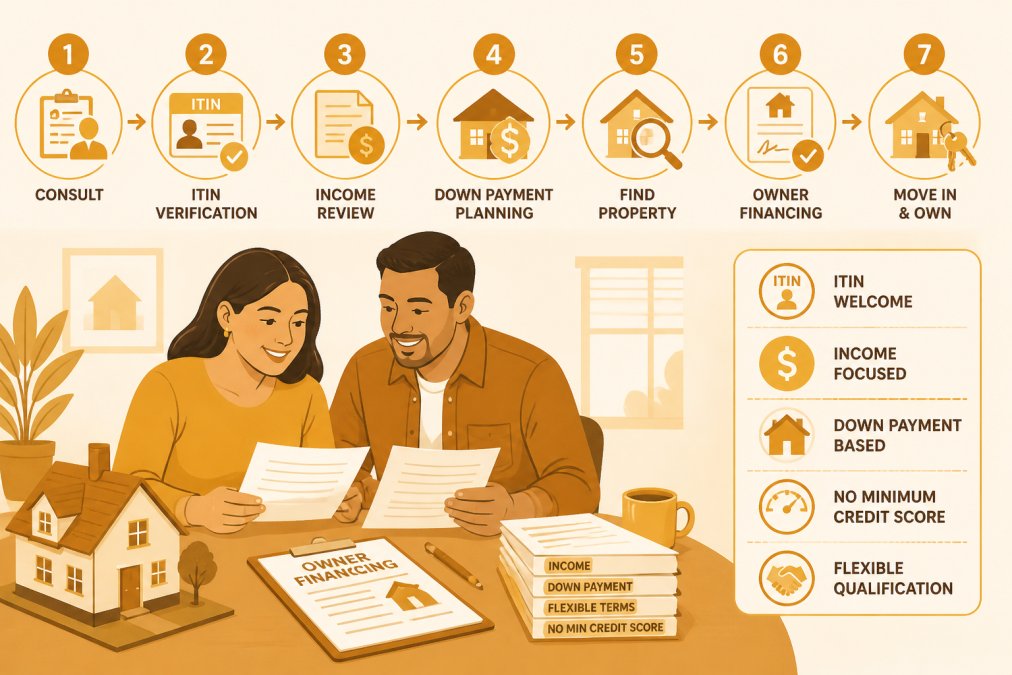
Next, get pre-qualified with lenders who specialize in ITIN mortgage loans. Pre-qualification shows sellers you're serious and reveals your actual buying power; many lenders provide it within one business day.
Begin your property search knowing your budget.
When you find a property, make an offer with your pre-qualification letter, sellers favor buyers with verified financing. Negotiate inspection periods and contingencies that protect your interests.
Once an offer is accepted, formal underwriting begins: the lender reviews documentation, orders an appraisal, and verifies income. This typically takes 30 to 45 days depending on documentation completeness.
Schedule a final walk-through 24 hours before closing to confirm the property's condition.
At closing, you sign documents transferring ownership and establishing the mortgage lien, and receive the deed showing you as owner. Congratulations, you're a homeowner.
Sold With Financing specializes in making this path accessible for ITIN holders and self-employed borrowers who face rejection from traditional lenders.
Homeownership transforms your financial future, but traditional lending often blocks the path for ITIN holders and self-employed borrowers. With no balloon payments, no prepayment penalties, and the deed in your name at closing, you own your home from day one. Learn more about alternative mortgage options for non-traditional borrowers and explore how owner financing can work for your situation.
Frequently Asked Questions
Can you get an ITIN mortgage loan without a credit score?
Yes. Many lenders offering ITIN mortgage loans do not require a minimum credit score. Instead, they focus on income verification, down payment amount, and debt-to-income ratio. Self-employed borrowers and 1099 contractors can qualify by providing bank statements, profit and loss statements, or other proof of income. This approach opens homeownership to ITIN holders and other non-traditional borrowers who may not have established credit history in the United States.
What documentation do you need to apply for an ITIN mortgage?
Required documentation typically includes your ITIN, proof of income (bank statements, P&L statements, or tax returns), identification, proof of down payment funds, and details about the property. Self-employed borrowers should provide 2 years of business records. Lenders may also request asset verification and proof of residency. The exact documentation depends on your situation and the lender's underwriting requirements.
How much down payment is required for an ITIN loan?
Down payment requirements for ITIN loans typically range from 10% to 30% of the purchase price, depending on the lender and your financial profile. Some lenders may accept lower down payments if you have strong income verification and assets. The loan-to-value ratio (LTV) affects both your down payment requirement and your interest rate, so a larger down payment can improve your loan terms.
Are ITIN mortgage rates higher than traditional mortgage rates?
ITIN mortgage rates are often higher than conventional mortgage rates because lenders view non-traditional borrowers as higher risk. Rates depend on your down payment, income documentation quality, debt-to-income ratio, and the loan term. Owner financing arrangements may offer fixed-rate options without the strict underwriting of traditional mortgages, making them an alternative for ITIN holders unable to qualify through banks.